What Is a Bluetti Portable Power Station?
A Bluetti portable power station is a rechargeable battery system with a built-in inverter, charge controller, display, and multiple output ports. You charge the battery from a wall outlet and, on compatible models, from solar panels, a vehicle, or another supported source. The unit then powers devices through AC outlets, USB ports, and DC connections without running a gasoline engine.
The useful distinction is simple: battery capacity tells you approximately how long stored energy may last, while inverter output tells you which devices the station can run at one time. A large battery with insufficient output cannot start a demanding appliance. A high-output inverter paired with a small battery may run that appliance, but only briefly. A good purchase balances both numbers.
A power station also differs from a “solar generator.” The power station is the battery and power electronics. A solar generator package usually means that same type of station bundled with compatible solar panels. If sunlight is part of your charging plan, read our dedicated Bluetti solar generator guide before choosing panels.
Short answer
Which size should you start with?
Choose a 1,000Wh-class BLUETTI for phones, laptops, lights, routers, campsite electronics, and shorter appliance runs when portability matters. Compare a 2,000Wh-class station when refrigerator backup, RV weekends, multiple devices, or longer outages are the priority. In either case, measure the highest simultaneous wattage and confirm startup surge before buying.
How to Choose a BLUETTI Portable Power Station
Product names are less important than the electrical job you need the station to perform. Write down the devices you expect to use, their watts, how many hours they must run, and which devices may start at the same time. Then evaluate these six factors.
1. Battery capacity in Wh
Watt-hours are the starting point for runtime. A 1,152Wh battery stores about half the energy of a roughly 2,000Wh battery. Not every stored watt-hour reaches an AC device because conversion, standby power, temperature, and load behavior affect usable energy.
2. Continuous and surge output
Continuous watts cover normal operation. Surge capability matters when compressors, pumps, and motor-driven appliances start. Add the loads that may run together and leave sensible headroom instead of planning at the inverter's absolute limit.
3. Battery chemistry
The models compared here use LiFePO4 battery chemistry. Chemistry is only one durability factor; cycle-life conditions, storage temperature, charge level, firmware, and daily use also influence long-term performance.
4. Recharge speed and inputs
Check wall-charging time, maximum solar input, supported solar voltage, vehicle-charging options, and whether the necessary cables are included. Fast charging is useful only when the available circuit or panels can support it.
5. Ports and power quality
Count AC outlets, USB-C power delivery, USB-A, and regulated DC ports. If you need pass-through or UPS-style operation, confirm the exact mode and transfer specification in the current manual for the exact model.
6. Weight, noise, and expansion
Higher-capacity stations are harder to move and their cooling fans can be audible under load or while charging. Compare handles, dimensions, weight, expansion-battery support, app features, warranty terms, and the route from storage to the place of use.
Bluetti Portable Power Station Model Comparison
These four models cover common compact, mid-size, and high-capacity buying needs. Specifications below reflect BLUETTI's currently listed capacity and output. Prices, bundles, coupons, and stock can change, so they are intentionally excluded.
| Model | Capacity / Output | Best starting use case |
|---|---|---|
| Elite 100 V2 | 1,024Wh / 1,800W | Apartments, road trips, mobile work, and compact emergency backup |
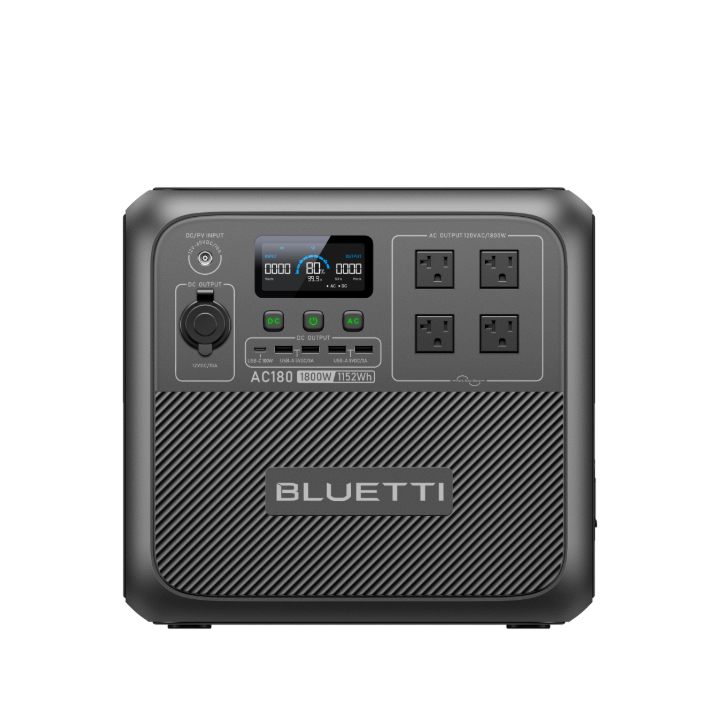
| AC180 | 1,152Wh / 1,800W | Camping, tailgating, small appliances, and balanced everyday use |
| AC200L | 2,048Wh / 2,400W | Refrigerator backup, RV weekends, and expandable home power |
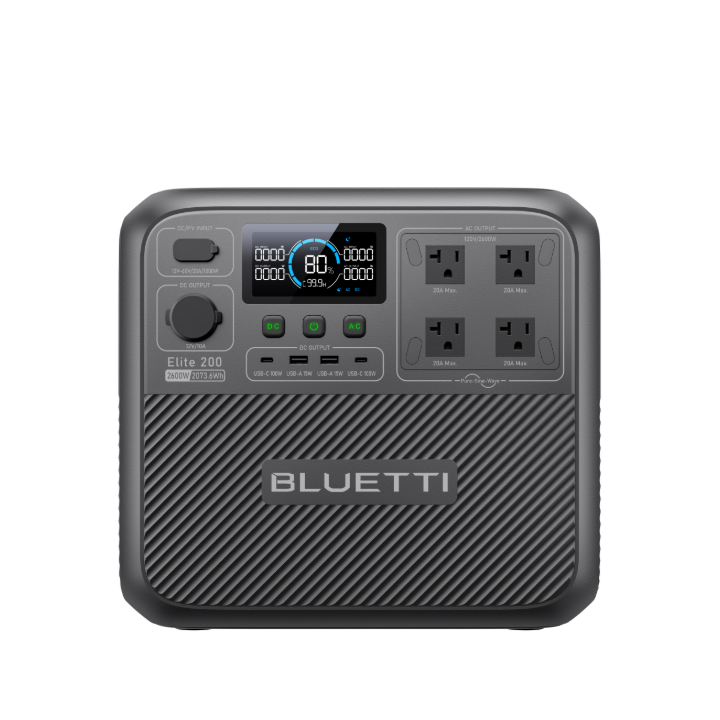
| Elite 200 V2 | 2,073.6Wh / 2,600W | Longer outages and heavier multi-appliance backup plans |
Elite 100 V2: compact 1,000Wh-class backup
The Elite 100 V2 combines 1,024Wh of capacity with 1,800W of listed output. It is a sensible comparison point for apartment backup, road trips, mobile offices, and buyers who want meaningful appliance capability without immediately moving to a 2,000Wh-class unit.
AC180: balanced camping and everyday power
The AC180 offers 1,152Wh and 1,800W. That balance makes it a common starting point for camping, tailgating, photography, remote work, and essential household loads. It is larger than a basic charging bank but more portable than the high-capacity models below.
AC200L: expandable home and RV backup
The AC200L steps up to 2,048Wh and 2,400W. It deserves comparison when a refrigerator, cooking appliance, power tool, RV setup, or a longer list of outage essentials pushes beyond the comfortable range of smaller stations. Confirm expansion compatibility and charging limits for the exact package you are considering.
Elite 200 V2: more output for heavier plans
The Elite 200 V2 is listed at 2,073.6Wh and 2,600W. Its additional output and battery margin can suit heavier simultaneous loads and longer backup windows, but buyers should plan where a unit of this class will be stored and how it will be moved before an outage.
How to Estimate Portable Power Station Runtime
Runtime claims become useful only when they are tied to a specific load. Start with the average watts your devices consume, not just the highest number printed on an appliance label. Then use a planning allowance for inverter conversion, battery management, and standby consumption.
Estimated hours ≈ battery watt-hours × 0.85 ÷ average load watts
The 85% factor is a planning assumption, not a guaranteed efficiency specification.60W combined load
A 1,152Wh station yields an illustrative estimate of about 16.3 hours.
100W average load
A 1,152Wh station yields an illustrative estimate of about 9.8 hours.
300W average load
A 1,152Wh station yields an illustrative estimate of about 3.3 hours.
600W average load
A 2,073.6Wh station yields an illustrative estimate of about 2.9 hours.
Real appliances rarely draw a perfectly steady load. Refrigerators cycle, power tools spike, fans change speed, and a power station consumes some energy simply by keeping its inverter active. Cold or hot conditions can also affect performance. Treat calculations as a sizing tool, then leave reserve capacity for unexpected use.
For refrigerator backup, measure energy consumption over time if possible and separately confirm compressor startup demand. For CPAP machines or other medically important equipment, follow the device manufacturer's guidance and maintain a backup plan rather than relying on a single consumer battery.
Wall, Solar, Vehicle, and Generator Charging
Charging flexibility is one of the strongest reasons to choose a portable power station, but every method has limits. The fastest advertised charging mode may require a suitable household circuit, specific settings, or a combination of inputs. Read the current manual before planning an emergency recharge schedule.
Wall charging
Wall power is usually the simplest way to prepare for a forecast storm or a trip. Charge the station in a dry, ventilated place on a circuit suitable for the charger's input. If the unit will be stored, follow BLUETTI's current storage and periodic-maintenance guidance rather than leaving it forgotten for months.
Solar charging
Solar can extend off-grid use when panel voltage, current, connectors, and total wattage fit the power station's supported input. Panel nameplate wattage is an ideal rating; clouds, heat, shade, sun angle, cable losses, and season affect real output. Never exceed the station's allowed voltage even when the total panel wattage appears acceptable.
Vehicle or fuel-generator charging
Vehicle charging can help during travel but is normally limited by the vehicle outlet and supported cable. A fuel generator may recharge a power station during a long outage, but the generator itself must be operated outdoors according to its safety instructions. The battery station does not make an indoor fuel generator safe.
Where a Bluetti Portable Power Station Fits Best
Home outage essentials
Build an outage list before shopping: modem and router, phones, LED lights, a fan, refrigerator, medical-equipment planning, and perhaps a laptop or television. Separate essential loads from comfort loads. Heating elements, electric cooking, space heaters, air conditioners, and well pumps can consume energy quickly or require more output than compact stations provide.
Camping and outdoor work
A portable station can quietly charge cameras, drones, laptops, lights, fans, coolers, and communication equipment. For tent or vehicle travel, compare weight, handle design, weather exposure, nighttime fan noise, and whether you can recharge before the return trip. A larger battery is not automatically better if it is too heavy to move between the car and campsite.
RV and van travel
RV owners should list both AC and DC loads and avoid assuming a portable station can replace the entire coach electrical system. Refrigeration, water pumps, coffee makers, induction cooking, air conditioning, and entertainment gear have very different demands. Confirm grounding, charging, and connection guidance for the exact setup instead of improvising adapters.
Remote work and apartment backup
A 1,000Wh-class model can provide useful continuity for networking gear, laptops, monitors, and phone charging without storing fuel. Apartment users should still plan a safe charging location, keep exits clear, and understand building rules. Buyers who only need a router and laptop may be better served by a smaller station than someone protecting a refrigerator.
Safety, Indoor Use, and Important Limitations
A BLUETTI battery station does not have an internal combustion engine, so it does not emit gasoline exhaust while powering devices. That does not make it risk-free. Treat it as high-energy electrical equipment and follow the manual supplied for the exact model and firmware.
- Keep the station, connectors, and charging accessories dry.
- Do not block ventilation openings or operate the unit under bedding or clothing.
- Keep it away from excessive heat, flames, corrosive environments, and physical impact.
- Inspect cables and plugs before use and stop if you notice damage, odor, swelling, or abnormal heat.
- Stay within continuous, surge, input, and per-port limits.
- Use compatible panels, cables, and charging accessories.
- Do not backfeed a home electrical panel through an improvised connection.
If a load is medically necessary, consult the device manufacturer and your clinician about power quality, alarms, backup duration, and a second source of power. For fuel-generator safety, follow FEMA's generator safety guidance; fuel-burning generators belong outdoors and away from doors, windows, and vents.
Buying Checklist Before You Click “Add to Cart”
- List every device, its running watts, startup surge, and required hours.
- Add simultaneous loads and leave output headroom.
- Estimate watt-hours with conversion and standby losses included.
- Confirm battery chemistry, storage guidance, and warranty terms.
- Check AC, USB-C, USB-A, and DC port quantity and ratings.
- Verify wall, solar, vehicle, and generator charging compatibility.
- Compare weight, dimensions, handles, fan noise, and storage location.
- Confirm the exact model, bundle contents, cables, and expansion compatibility.
- Review the seller, shipping restrictions, return policy, and current manufacturer support terms.
- Ignore stale prices and ratings; inspect the live listing before purchase.
Amazon listings and coupons change frequently. This site uses affiliate links and may earn a commission from qualifying purchases without increasing your price. Read the full affiliate disclosure before buying.
View Current BLUETTI AvailabilityHow This Guide Was Prepared
This is an editorial buying guide, not a claim of hands-on laboratory testing. Capacity and output values were checked against current BLUETTI product pages. We compare specifications, intended use, sizing logic, charging requirements, and practical limitations. We do not publish a fabricated star rating, fixed Amazon price, or unverified runtime promise.
Readers who want a second BLUETTI-focused comparison can visit our Bluetti power station buying guide. Always confirm the manual, seller, included accessories, warranty, and final specifications for the exact model and region.
Bluetti Portable Power Station FAQ
Which Bluetti portable power station is best for most people?
The BLUETTI AC180 is a practical place to start for buyers who want a balance of 1,152Wh capacity, 1,800W output, and portability. The Elite 100 V2 is another compact 1,800W option, while the AC200L and Elite 200 V2 provide roughly 2,000Wh of capacity for longer appliance and outage backup. The best choice still depends on the wattage and runtime of your own devices.
Can a Bluetti portable power station run a refrigerator?
A properly sized BLUETTI power station can run many refrigerators. Check the refrigerator's running watts and startup surge, then confirm that the power station's continuous and surge output can support both. Runtime varies with battery capacity, compressor cycling, room temperature, inverter losses, and other connected devices.
Can you charge a Bluetti portable power station with solar panels?
Many BLUETTI models accept solar charging, but compatibility is model-specific. Confirm the station's supported solar voltage range, current limit, maximum input, connector, and the panel's open-circuit voltage before connecting panels.
Is a Bluetti portable power station safe to use indoors?
A battery power station does not burn gasoline while supplying power, so it does not create engine exhaust at the point of use. It is still electrical equipment: keep it dry, allow the ventilation required by the manual, use approved charging accessories, avoid damaged cables, and stay within its input and output limits. Fuel-burning generators must remain outdoors and away from openings.
How long does a Bluetti portable power station last on one charge?
A useful planning estimate is battery watt-hours multiplied by an efficiency allowance, divided by the average device watts. For example, a 1,152Wh battery using an 85 percent planning allowance would support a steady 100W load for roughly 9.8 hours. Actual runtime can be shorter or longer depending on load behavior, temperature, conversion losses, standby use, and battery condition.
Can a Bluetti power station work as a UPS?
Some BLUETTI models provide pass-through or UPS-style functions, but transfer time, supported loads, operating mode, and setup vary by model. Check the current manual for the exact unit and do not assume that a consumer power station is a substitute for a medical-grade or data-center UPS.